


Quick Summary: The Blogs to Write and How to Write Them Well
- Different blog formats serve different business goals. A how-to guide, a listicle, a case study, and a comparison post each do a different job.
- Your opening sentence sets the tone for everything that follows. A specific, relatable hook performs better than a generic intro every single time.
- Headers matter. Structure, paragraph length, and keyword placement all affect how Google reads your content and how readers experience it.
- Maximise meta descriptions and internal links. These are two of the most underused formatting tools in blogging.

Four in five internet users read blogs. Most business owners know that blogging should be part of their content marketing efforts. However, getting from “I should write something” to a published post that ranks is where things fall apart. Knowing which blogs to write and what structure to follow makes the difference between a post that performs well and a post that doesn’t get noticed.
The good news is that the problem is usually structural, not creative. Pick the right format, a good sentence starter, and format it properly, and you have a post that earns its place on your site.
4 Sentence Starters To Follow for Blogs
Before getting into the types of blogs to write, you must first know how to start one. The first sentence of a blog is the one that keeps someone on the page or loses them. A strong opener sets a specific scene, asks a pointed question, or drops a surprising stat. Vague intros do nothing.
Scenario-Led openers
Drop the reader into a situation they recognise before you say anything else. For example, “You’ve published six blog posts this year, and none of them have ranked” earns attention because it names a specific frustration. It creates immediate contrast without being dramatic about it. The scenario just needs to be true to what your reader is experiencing right now.
Stat-Led openers
A surprising number of stops the scroll faster than most sentences can because it tells a reader something they probably didn’t know. Lead with the stat, then let the rest of the post explain why it matters.
Direct address
Some of the strongest openers skip the setup entirely and speak directly to the reader. Give someone a reason to keep reading immediately. For instance, instead of writing “Your blog is the place where potential clients decide whether to trust you,” you can write something like “Most business blogs fail at the first paragraph,” which does the same job in fewer words.
Challenge-Based openers
This style mirrors the way people search, which makes them strong for SEO content. “Getting found on Google is harder than it was three years ago” speaks to something your reader has probably already felt. “Publishing a blog post every month and seeing zero traffic is demoralising” validates the frustration without overdramatising it.
The goal? Make your reader feel seen before you offer them anything.
5 Blog Formats to Write
Knowing which blogs to write comes down to matching the format to the goal. Each format has a different job, and using the wrong one for the wrong purpose produces content that reads well but converts poorly.
The How-To Guide
When it comes to blogs to write, people who look at a how-to post already know what they want. They’re looking for a process, and they want someone to walk them through it. That makes this one of the easiest formats to rank with, because the search intent is explicit.
The format suits any business where knowing how something works is part of the reason clients hire you. If your service involves a process your client doesn’t fully understand, a how-to post is almost always worth writing.
The Listicle
One of the most popular blogs to write is listicles. However, it gets a bad reputation because bad ones exist in abundance. The format itself is sound. Readers scan before they commit, and a numbered list tells them immediately what they’re getting and how long it will take. Google rewards the structure, too. Listicles pick up featured snippets more reliably than most other formats. That said, each item needs to have value. A list of five shallow points is worse than a list of two good ones.
The Case Study
A case study is the only blog format where you stop talking about what you can do and show what you did. This matters enormously for service businesses with longer sales cycles, where a potential client might read several pieces of your content before picking up the phone.
Keep the structure simple: what was the problem, what did you do, what happened as a result. Vague outcomes do nothing.
The Comparison Post
Another type of blogs to write you shouldn’t miss is comparison posts. This captures readers at the decision point, which is why they convert well even when they don’t rank for high-volume keywords. Someone at that stage has already done their basic research and is weighing up options. A balanced comparison that genuinely helps someone choose builds more trust than a post that steers them toward a predetermined answer. If readers sense the deck is stacked, they leave.
The Thought Leadership Post
Every other format on this list answers a question. Thought leadership takes a position. It challenges a common assumption or offers a perspective that only comes from years of doing the work.
Use this format when you want to attract clients who are choosing between professionals. Those readers are looking for someone with a point of view rather than just a list of services.
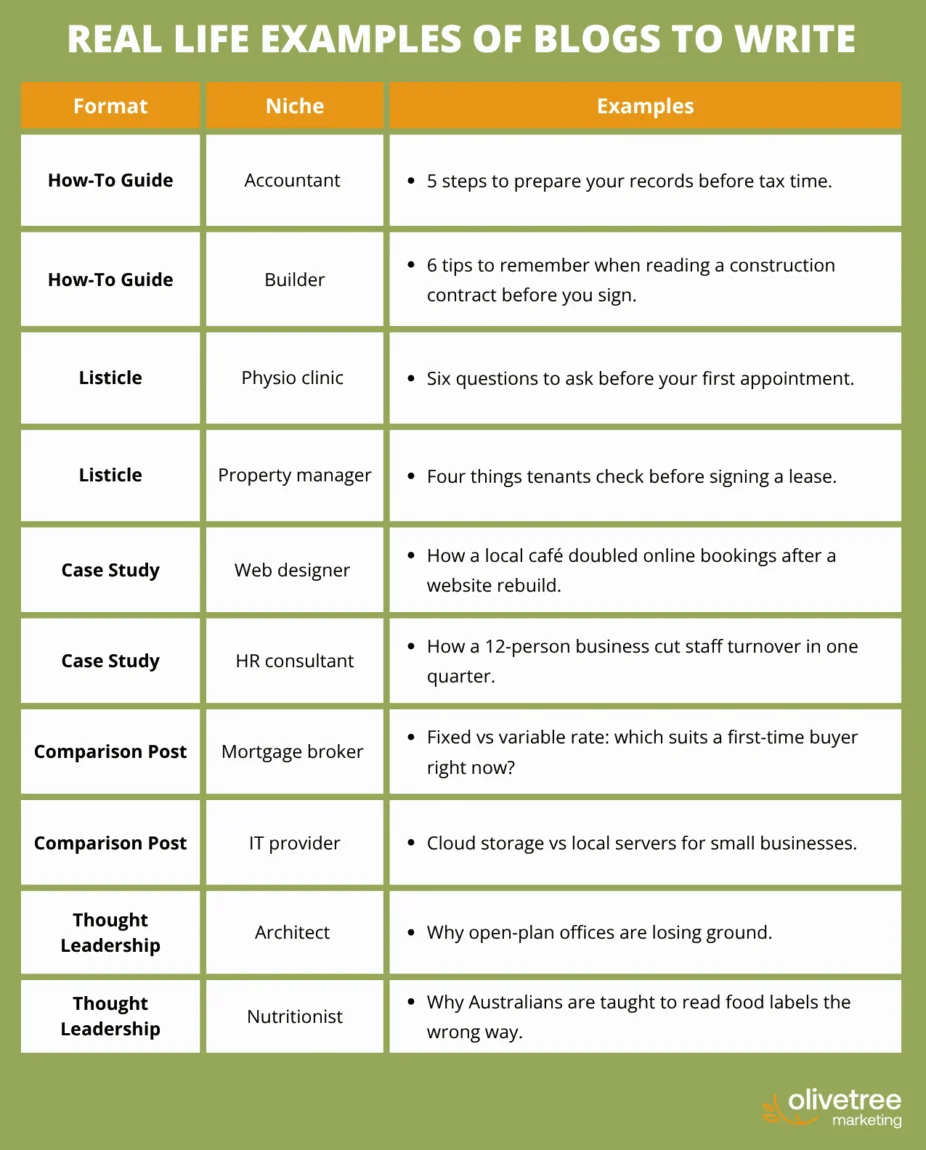
How Do I Format a Blog Post for Readability and SEO on a Typical Blogging Platform?
Choosing the right blogs to write format is the first job. Formatting the post well is what helps it rank on Google. Knowing how to write a blog post that performs means treating structure seriously.
Prioritise header structure
H2s and H3s guide readers through the post and signal topic relevance to Google. Your H1 should include your primary keyword naturally. Meanwhile, H2s should cover the major themes of the post. H3s should break down specific sub-points within those themes. Avoid vague headers. For example, “Let’s Dive In” tells Google nothing.
Paragraph length affects reading behaviour
Two to four sentences per paragraph is the standard for blog content. Long, dense blocks of text push readers back to the search results page.
Short paragraphs feel more credible and more readable on mobile, where most readers now access content.
Keyword placement follows a simple pattern
Use your primary keyword in the H1, in the first 100 words of the body copy, in at least one H2, and once or twice more in the body. Use it where it reads naturally. Forcing keywords into sentences that don’t need them hurts readability without helping rankings.
Meta descriptions directly affect click-through rates
Write a meta description of 150 to 160 characters that summarises the post, includes the primary keyword, and gives the reader a reason to click. It won’t affect ranking, but think of it as a one-line pitch.
Internal linking supports both SEO and the reader’s experience
Every blog post should link to at least one or two relevant pages on your site. If you work with a team that provides blog content writing services, each post they produce should link back to your core service pages, location pages, and related posts. Internal links tell Google how your site is structured and keep readers moving through your content.
Images need alt text
Every image on your blog should carry a short, descriptive alt text that includes a relevant keyword where it reads naturally. Alt text improves accessibility and helps your images appear in image search results.
Case Study: What Targeted Blog Content Does
A healthcare fitout provider came to Olivetree Marketing with decades of expertise and almost no presence on Google. Their ideal clients, including dentists, GPs, specialists, and veterinarians, were searching for fitout specialists every day and not finding them.
The content strategy focused on deciding which blogs to write. In this stage, we found out that high-intent, service-specific topics matched exactly what those clients were searching for. Blogs, service pages, and location pages were produced consistently, each one built around a genuine question or decision a potential client would have before hiring a fitout company.
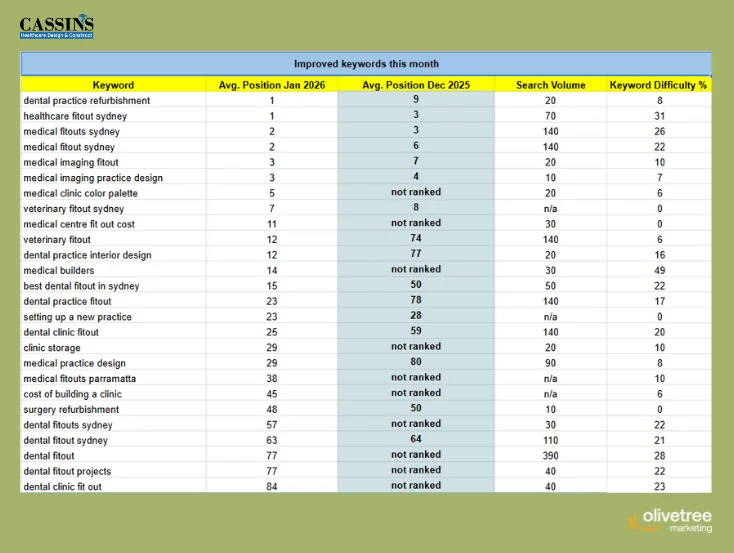
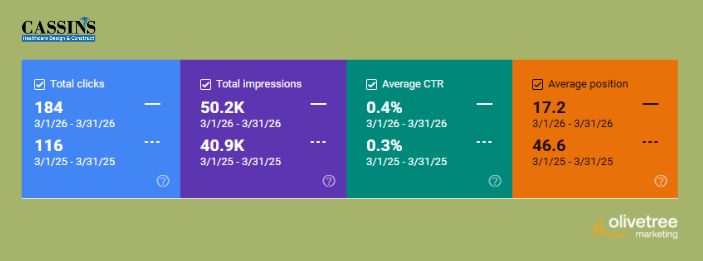
Average position in Google Search Console improved from 46.6 to 17.2 in twelve months, and several keywords moved from no ranking at all to the first page of Google within a single month. The content also gave Cassins a foundation strong enough to earn citations across ChatGPT, Google AI Mode, and Google AI Overviews, reaching clients even earlier in their research process.
A business that had built its reputation entirely through referrals now had a digital presence that worked just as hard.
Read more about this case study here.
Knowing Which Blogs to Write Is Just The Beginning
A single well-written post won’t make much of a difference. Search rewards consistency, and building a blog that compounds in traffic and authority takes sustained effort across keyword research, writing, and optimisation.

The truth is, producing blogs to write is hard. You have to create content consistently, research, and make sure each post attracts the right readers, which takes time that most business owners simply don’t have.
Olivetree Marketing works with small and medium businesses across healthcare, construction, NDIS, property, and finance to do exactly that. If you don’t know what blogs to write, let’s change that. Contact us today.